
The Relationship Between the EU and Syria (2)
The 1970s – The EEC-Syria Cooperation Agreement
This paper is the second of a series of six papers examining the relationship between the European Union (including its earlier institutional incarnations) and Syria. Drawing on diplomatic archives, grey literature, trade statistics, and contemporaneous policy documents, the series seeks to shed light on a scarcely documented relationship that has oscillated between strategic pragmatism and political estrangement. By tracing the evolution of diplomatic contacts, trade flows, aid conditionality, and cooperation frameworks, the series aims to unpack how economic interdependence often preceded political alignment and how mutual caution repeatedly constrained deeper integration.
Launching the Global Mediterranean Policy
In the early 1970s, the European Economic Community (EEC) embarked on its so-called ‘Global Mediterranean Policy’ to unify the policies it had used to address its Southern neighbourhood to that point. While the bloc had already signed various agreements with some Southern European and Mediterranean countries, these were far from representing a unified approach. These case-by-case agreements resembled ‘uncoordinated responses to external stimuli’ rather than a coherent policy.1
To make up for this lack of unified policy, then, the Commission launched, in 1972, the ‘Global Mediterranean Policy’. At the time, several factors made such a policy necessary.
First, heightened tensions between the United States and the USSR in the Mediterranean–the EEC’s ‘backyard’–pushed the EEC to take its destiny into its own hands and try to expand its influence in the region. Second, Western Europeans sought to secure their oil supplies, with about 18.5 per cent coming from Mediterranean countries. Third, the Commission also sought to secure Mediterranean markets to which a large share of its exports was directed. In addition, the Commission also had other economic factors in mind when devising this policy, such as investment opportunities and migrant labour–the former outbound, while the latter inbound.2
Within this context, in a communication to the EEC member states, the European Commission stressed that increased cooperation with Syria and the provision of additional financial support would be ‘beneficial for the Community itself, as it would facilitate the provision of capital goods, expertise, and the necessary technology for the implementation of the projects being financed.’3
Within the context of the Israeli-Arab conflict, the Global Mediterranean Policy also had a political dimension. The EEC sought to position itself as a mediator in the region, promoting stability through economic cooperation while gradually asserting a more independent role from the United States. This was particularly relevant following the 1973 Yom Kippur War and the ensuing oil crisis, which underscored Europe’s vulnerability to Middle Eastern geopolitics. By strengthening ties with Arab Mediterranean states, the EEC aimed to balance its relations with both Israel and the Arab world while ensuring continued access to vital energy resources.
Whether this ‘Global Mediterranean Policy’ was successful or not is not the argument of this research; however, it is within this context that the EEC would seek to develop its relations with Syria via the signing of a cooperation agreement.
While Syria had established diplomatic ties with the EEC in the 1960s (Read ‘The Relationship Between the EU and Syria (1) — The 1960s’), its engagement remained limited and primarily economic. Content with strengthening its ties with the USSR and wary of deeper Western alignment, Damascus had shown little enthusiasm for significantly expanding its relationship with Brussels until the mid-1970s, when political and economic pressures made cooperation with the EEC more attractive. Despite its closeness to Moscow, Syria’s alignment with the USSR was not blind nor absolute. A key moment illustrating this diplomatic flexibility came in August 1972, when Syria participated in the Georgetown Conference of the Non-Aligned Movement (NAM), sending a delegation led by Foreign Minister Abdel Halim Khaddam. French observers interpreted Syria’s increased involvement in the NAM as a sign of its desire to avoid exclusive dependence on the Soviet Union.4
Damascus’ diplomatic flexibility also shone on March 26 and 27, 1974, during a series of meetings between the European and Syrian delegations in Damascus. At the time, the Syrians expressed their interest in opening negotiations with Brussels to deepen their diplomatic and commercial relations, something which greatly surprised Europeans diplomats, who, in a communication from the Commission to the Council, stated that Syria “has always shown a clear reservation in the past” regarding its desire to further its cooperation with the EEC.5
The fact that Damascus’s interest in deepening its ties with the EEC in early 1974 is not surprising, however. Historically aligned with the Soviet Union and cautious in its dealings with Western entities, Syria began actively pursuing negotiations with the EEC as part of a broader strategy to balance its international relations, diversify its economy, and reduce its over-reliance on a single ally. The aftermath of the October War had placed a significant strain on Syria’s economy, which, combined with the rising cost of imports from Western countries, exacerbated by the 1970s energy crisis, further worsened the country’s trade balance. As a result, faced with these economic pressures, Syria sought engagement with the EEC to access new markets, secure financial aid, and obtain technological support, thereby addressing immediate economic concerns while maintaining its sovereignty and strategic interests.
In 1973, bilateral trade with the EEC represented 32.9 per cent of Syria’s total foreign trade.6 Syria’s following year to reach EUA 231.1 million. The EEC’s favourable position as a supplier was primarily due to the high technical level of its industrial production, which aligned with the equipment needs of Syrians. However, Syrian products’ limited reach in the markets of Community countries was due to the mediocre quality of many local industrial products and Syria’s delivery commitments to certain Eastern European countries under previous barter agreements.7
As a result, the growing economic difficulties due to an unfavourable trade balance meant that the Syrian government was doubtful that it could reach the objectives of this fourth five-year plan spanning (1976-1980)8–which most notably entailed the doubling of the country’s gross domestic product (GDP) over the next seven years–without support from the EEC.
On February 4, 1976, the then Deputy Minister of the Syrian Ministry of Economy and Trade Ammar Jamal explained that “it is understood that Syria, besides the efforts it has to make to reach [its] objectives, must, on the one hand, count on cooperation and aid from friendly countries and, on the other hand, must revise its position regarding its commercial exchanges.”9 “Undoubtedly, as you know, our trade balance with the EEC is in deficit,” declared Mr Jamal, who continued by arguing that “this deficit has increased very rapidly in recent years. It was around 126.8 million SYP in 1970; it rose to 885.7 million SYP in 1974. The deficit will undoubtedly exceed this figure in 1975.” At the same time, Mr Jamal explained that, to reduce the deficit, Syria needed to increase its exports, which require substantial funds to boost production, something the EEC could help Damascus with.10
In fact, the period during which the cooperation agreement between the EEC and Syria was negotiated was marked by other attempts by Damascus to address its trade balance. In the first nine months of 1974, Syria signed more than a dozen bilateral agreements with Western and Eastern countries, including several trade agreements.11
In parallel, 1974 was marked by Damascus’ significant opening vis-à-vis the West, as shown by growing trade flows and the resumption of ties with major Western Powers, including the United States in June and the Federal Republic of Germany in August. This thaw in the relationship between Damascus and Washington following the October War also enabled a significant American loan of 75,000 tonnes of wheat flour and 25,000 tonnes of rice, repayable over 20 years.12
In addition to these factors, the launch of the ‘Global Mediterranean Policy’ led the EEC to open negotiations on January 23, 1975, with four Mashreq countries—Syria, Egypt, Lebanon, 13 and Jordan.14 On February 4 and 5, 1976, the first bilateral negotiations between the EEC and Syria took place and were concluded in October of the same year.15
The Cooperation Agreement
Following the completion of the negotiation process and a common agreement found with Syria and the other Arab countries, with the exception of Lebanon, Europeans once again stressed the importance of signing such an agreement with Syria, recalling that this event contrasts sharply with the reserved attitude of Syria vis-à-vis the European Communities only a few years earlier.16 Moreover, the nature of the agreement was also considered a significant win for the European diplomats, who argued that, since the cooperation agreement was signed for an unlimited period, it fostered a common vision for long-term cooperation among the two parties.
Besides their unlimited nature, these agreements also included two other “essential characteristics”, namely their comprehensiveness and their evolutionary nature, and provided for the establishment of common institutions.17


Summary of the EEC-Syria Cooperation Agreement
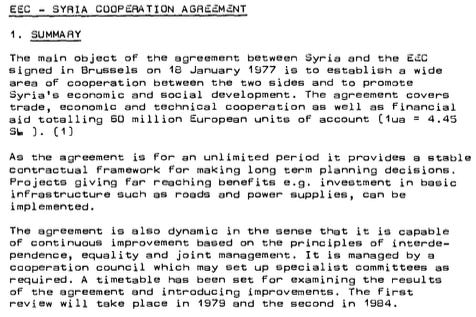
The main object of the agreement between Syria and the EEC signed in Brussels on 18 January 1977 is to establish a wide area of cooperation between the two sides and to promote Syria’s economic and social development. The agreement covers trade, economic and technical cooperation as well as financial aid totalling 60 million European units of account (1ua = 4.45 sp ).
As the agreement is for an unlimited period it provides a stable contractual framework for making long term planning decisions. Projects giving far reaching benefits e.g. investment in basic infrastructure such as roads and power supplies, can be implemented.
The agreement is also dynamic in the sense that it is capable of continuous improvement based on the principles of interdependence, equality and joint management. It is managed by a cooperation council which may set up specialist committees as required. A timetable has been set for examining the results of the agreement and introducing improvements. The first review will take place in 1979 and the second in 1984.
By virtue of its globality, the agreement provides for cooperation in the economic, financial, and commercial sectors. Economic cooperation encompasses infrastructure development and cooperation in industry, science, technology, environmental protection, research, and development, while financial cooperation relates to the bilateral financial protocol covering the period 1977-1981, granting Syria various loans from the European Investment Bank (EIB) and non-reimbursable aid of 60 million EAU, equivalent to 267 million SYP.18 As for trade cooperation, the cooperation agreement enshrines the most-favoured-nation clause between the bloc and Syria, and ultimately aims at the total and gradual abolition of customs duties between the European and Syrian markets.19
The evolutionary nature of the cooperation agreement is reflected in a general review clause that allows the agreement to be revised and improved, if necessary, on dates previously agreed by the parties. Regarding the monitoring of the agreements, a Cooperation Council was set up, composed of representatives of both parties, responsible for ensuring compliance with and the proper functioning of the agreements, and, as necessary, proposing certain reorientations.20
On January 18, 1977, the EEC and Syria signed a cooperation agreement that has served as the basis for relations between Brussels and Damascus to this day (when the context allows). This agreement serves as the primary channel for the bilateral relationship, encouraging dialogue, cooperation, and assistance between the two parties.
It should be noted, however, that this agreement concerns only trade, the economy, and technical cooperation and, in fact, does not include any provision for political dialogue. For this, we will have to wait for the “Barcelona Declaration” of November 1995, adopted by Syria jointly with the European Union, its fifteen Member States at the time21 and eleven other Mediterranean countries.22
Conclusion
The 1970s marked a turning point in EU-Syria relations, shifting from limited engagement to a structured and institutionalised partnership. The 1977 Cooperation Agreement symbolised Syria’s increasing reliance on European economic and technical assistance, particularly amid its growing trade deficit and development ambitions. While this agreement provided financial aid, trade benefits, and technological support, it remained exclusively economic in nature, with no political provisions—a key limitation that would shape future interactions.
Despite this deeper engagement, the foundations of EU-Syria relations remained fragile. Syria’s economic ties with the EEC expanded throughout the late 1970s, but they were driven more by necessity than strategic alignment. The cooperation framework offered Syria financial relief and trade advantages, yet the structural weaknesses of the Syrian economy—its dependence on foreign aid, continued trade imbalances, and reliance on barter agreements with Eastern Bloc countries—persisted.
As Syria entered the 1980s, relations with the EEC continued under the same cooperation framework, with few substantial changes. A second financial protocol (1982-1986) provided further economic support, yet diplomatic tensions surfaced. The Hindawi Affair in 1986, in which Syrian intelligence was implicated in an attempted terrorist attack, led to the EEC imposing economic sanctions on Damascus. These sanctions, though largely symbolic, demonstrated the vulnerability of Syria’s relationship with the EEC and the increasing role of political concerns in shaping European engagement. By the late 1980s, while trade and economic cooperation remained in place, diplomatic relations had become more fragile, foreshadowing the tensions of the decades to come.
Loukas TSOUKALIS, The EEC and the Mediterranean: Is ‘Global’ Policy a Misnomer?, International Affairs. 1977.
Ibid.
General Secretariat of the Council of the European Union, Accord de coopération entre la Communauté économique européenne et la République arabe syrienne, signé à Bruxelles le 18.01.1977. (Règlement (CEE) n° 2216/78 du Conseil du 26.09.1978 concernant la conclusion de l’accord de coopération entre la Communauté économique européenne et la République arabe syrienne, Archives historiques CM 2/1978 n° 370.2).
Tannous, Manon-Nour. Chirac, Assad et les autres. Les relations franco-syriennes depuis 1946. Presses Universitaires de France, 2017.
Archives historiques CM 2/1978 n° 370.2, op. cit.
General Secretariat of the Council of the European Union, 9ème rapport : situation économique et financière de la Syrie du début 1973 à la fin 1974, Archives historiques CM2/1975 n° 2066.
Ibid.
Syria’s five-year plans are comprehensive economic and social development strategies that have been a central feature of the country’s governance for several decades. These plans set national priorities and guide economic policy over successive five-year periods. Their origins date back to the era of socialist reforms and centralised planning that began with the Syrian–Egyptian union in 1958.
Archives historiques CM 2/1978 n° 370.2, op. cit.
Ibid.
Between January and September 1974, Syria signed bilateral agreements with the following countries: Bulgaria (February 4 and 19, and April 4, 1974); Hungary (February 17 and March 27, 1974); the U.S.S.R. (March 4 and August 26, 1974); Iraq (March 8 and April 1, 1974); the German Democratic Republic (March 28, 1974); Czechoslovakia (March 29 and August 5, 1974); Romania (April 25, 1974); North Korea (May 21, 1974); Iran (May 21, 1974); France (July 12, 1974); Lebanon and Jordan (September 3, 1974); and Austria (September 2, 1974).
Agreement for Sale of Agricultural Commodities (United States of America–Syrian Arab Republic), signed 20 November 1974, 1006 UNTS 58 (entered into force 20 November 1974).
The EEC quickly abandoned discussions regarding an association agreement with Lebanon due to the civil war that began on April 13, 1975.
Archives historiques CM 2/1978 n° 370.2, op. cit.
General Secretariat of the Council of the European Union, Accord de coopération entre la Communauté économique européenne et la République arabe syrienne, signé à Bruxelles le 18.01.1977. (Règlement (CEE) n° 2216/78 du Conseil du 26.09.1978 concernant la conclusion de l’accord de coopération entre la Communauté économique européenne et la République arabe syrienne, Archives historiques CM 2/1978 n° 370.5).
Ibid.
Ibid.
Grants made up one-third of this financial support package.
Commission of the European Communities, EEC-Syria Cooperation Agreement. 1977.
Ibid.
Germany, Belgium, France, Italy, Luxembourg, Netherlands, Denmark, Ireland, United Kingdom, Greece, Spain, Portugal, Austria, Finland, Sweden.
Algeria, Cyprus, Egypt, Israel, Jordan, Lebanon, Malta, Morocco, Syria, Tunisia, Turkey, Palestinian Authority.
👏👏